Skip to content
Raid LeaderPlay free
Every feature

What a raid leader does

13 classes and 39 specs, 8 questing zones, 14 dungeons, 5 raids with 20 bosses, 8 world bosses, 5 ships at sea and 73 achievements. Here is everything, in the order a guild meets it.

The loop

Found a guild with nothing, and build it into one that clears the final raid.

Start from nothing

Found a guild with nothing, recruit a few level-1 hopefuls and watch them level in the open world. Then pick five and lead them through a dungeon, pull by pull, until the raid opens and you pick twenty.

  • Guild levels open the next thing: a bigger roster, the introductory raid at guild level 4, the 20-player raids at 6.
  • Better recruits apply as your renown grows, and boss loot gears them up.
  • Or tick Quick start and skip ahead to a levelled, raid-ready guild.
The morning briefing

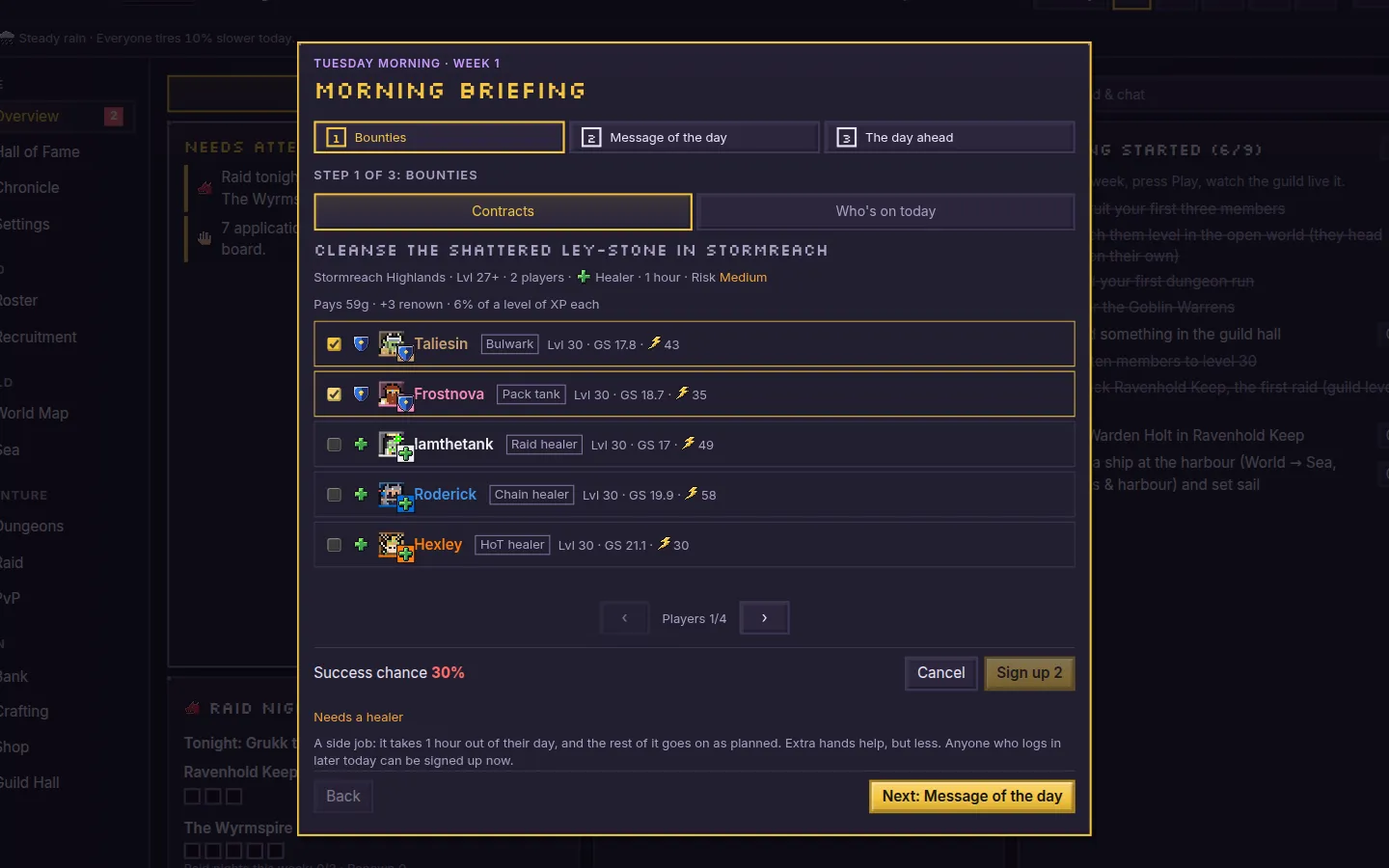
Every day opens with a briefing in three steps: staff the bounty board, post the message of the day, then read the day ahead.

  • Bounties are the only contracts, handed out here, so this is how you group people up.
  • Every message of the day has an upside and a downside, and the guild reacts to it by temperament.
  • The day ahead brings an omen, a ley-line surge, a storm front or a heatwave, and who logs in when.
  • Then players decide their own day: quest while levelling, farm or train at the cap, rest when spent.
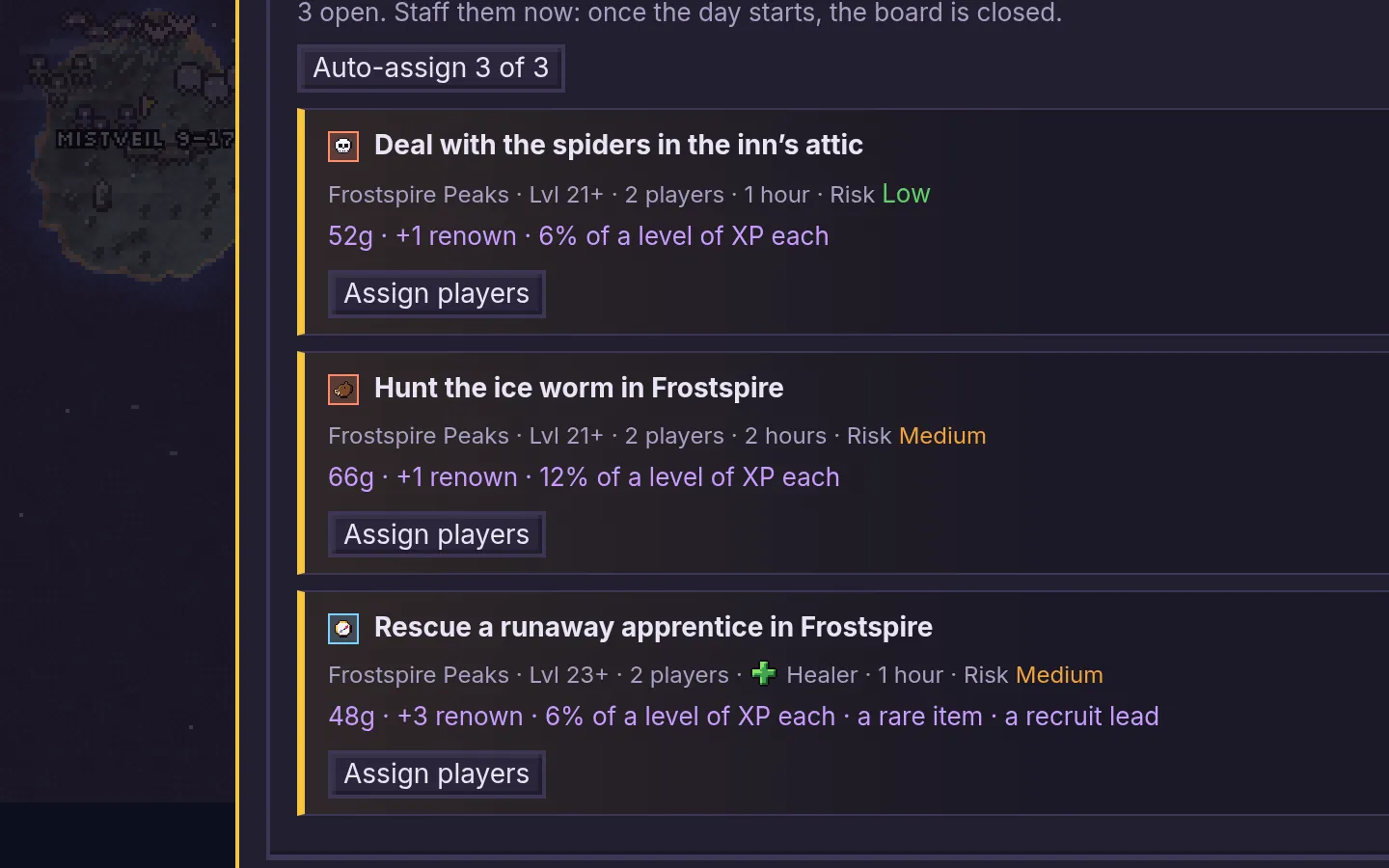
The morning briefing: a bounty is staffed by hand, two players ticked and signed up, and it shows on the bounty board as signed up.

Real play sessions

Nobody plays all day. Each player plays about 4 to 8 hours a day, logging in at their own time, and only works while online.

  • Out of energy, they rest offline until fresh; only a raid gets them to log in on a day off.
  • In a dungeon or raid nobody logs off, however tired: they underperform instead.
  • You watch them walk the pixel-art world map, which freezes while the game is paused.

Recruiting

The roster holds 5 at guild level 1 and grows with guild level (22 when the raid opens), and there are always more applicants than spots.

  • New guilds attract casuals; higher guild levels attract dedicated players and nolifers who stay up late.
  • A weekly ad in trade chat draws three more, and can ask for a class.
  • Veterans at level 30 start applying once the guild can raid.

Your guild

Automated players with skill, personality and needs. You keep them happy enough not to quit.

Classes and specs

The classic eight play as Vanguards, Zealots, Grovetenders, Penitents, Earthwardens, Chronomancers, Swashbucklers and Beastwardens, next to classes of the game’s own: the Necromancer, the Bard, the Tinker, the Hexer and, once the guild has sailed, the Corsair.

  • Every class brings one utility nobody else has: Hold the Line, Divine Touch, Rise and Shine, War Drums, Sheepify, Encore, Jinx and more.
  • Only priests, mages, rogues, rangers, necromancers, bards and hexers can drop threat.
  • Some classes travel their own way: a charger, stag form, a clockwork mech, a bone steed, or a spell home.
Browse every class and spec

Spec kits

Every spec has its own resource, a generator, a spender and an ultimate, with three versions of each, so two players of the same spec play differently.

  • Quick or heavy generators, frequent or overcharged spenders, burst, long or frequent ultimates.
  • Signature abilities with their own shapes: chains, cleaves, piercing lines, novas, burning ground, pets and totems, heal chains, shields and rings.
  • Damage dealers interrupt, tanks taunt, healers dispel: all only as well as each player’s skill allows.
See every kit

Characters with a past

Nine races, each with a racial (Dwarf Stoneskin, Gnome Slippery, Troll Juju Rush...), three genders, 25 personality traits and around 200 names.

  • A hidden skill that shows in how they play: awareness to dodge and hear calls, consistency to keep up the damage.
  • Needs: morale, energy, loot satisfaction, social and ego.
  • Friendships and rivalries. Unhappy players grumble, then quit and take their gear with them.
Races and traits in the codex
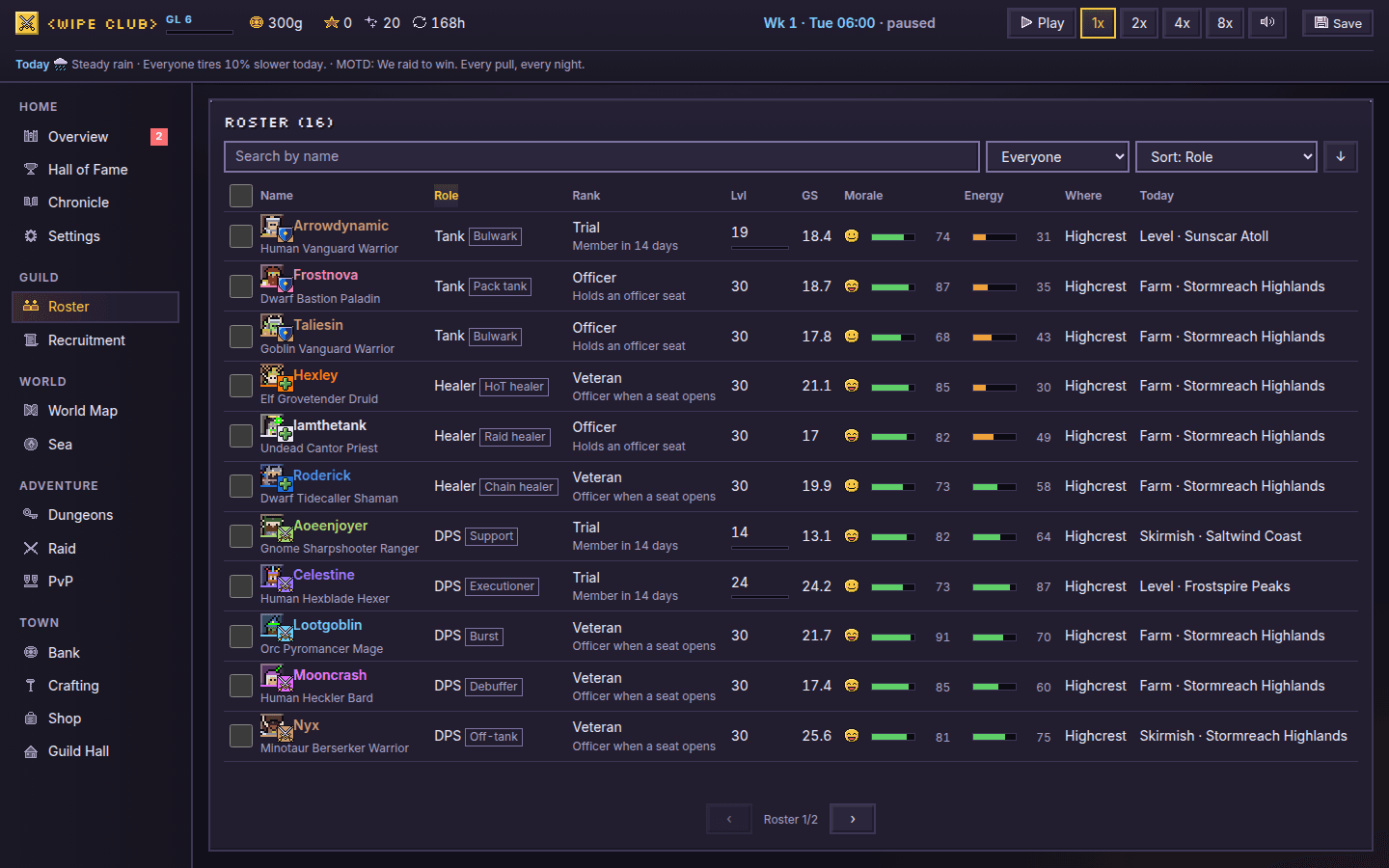
The roster: sixteen guildmates with role, rank, level, gear score and morale.

Loot and the loot council

Drops go straight onto whoever they upgrade most. In a raid, the loot council is yours, and it makes or breaks morale.

  • Picking a winner shows the consequence first: the winner’s gain and every passed-over raider’s loss.
  • Greedy players take a pass twice as hard; sensitive ones lose morale.
  • Anything nobody needs is disenchanted into components for the guild bank.

Officers and ranks

Guild ranks follow seniority and level, with limited seats at the top. A dungeon the group outgears by 5+ item levels can go to an officer instead.

  • Send an officer resolves the run on the spot and leaves a report.
  • Send and watch plays the very same run out in the arena, pull by pull.
  • Officers pull everything in order: a smaller chest, loot by free roll.

Guild life

A recruitment board fed by renown, a guild hall you upgrade, crafting from components, narrative events and a guild chat that talks back.

  • Six guild hall facilities with upkeep: a Great Hall for more roster spots, a Crafting Station, Training Grounds and more.
  • Paid respecs, narrative events with real choices, rival guilds on a server leaderboard.
  • Achievements for every first: first recruit, first clear, first kill.
Facilities and achievements
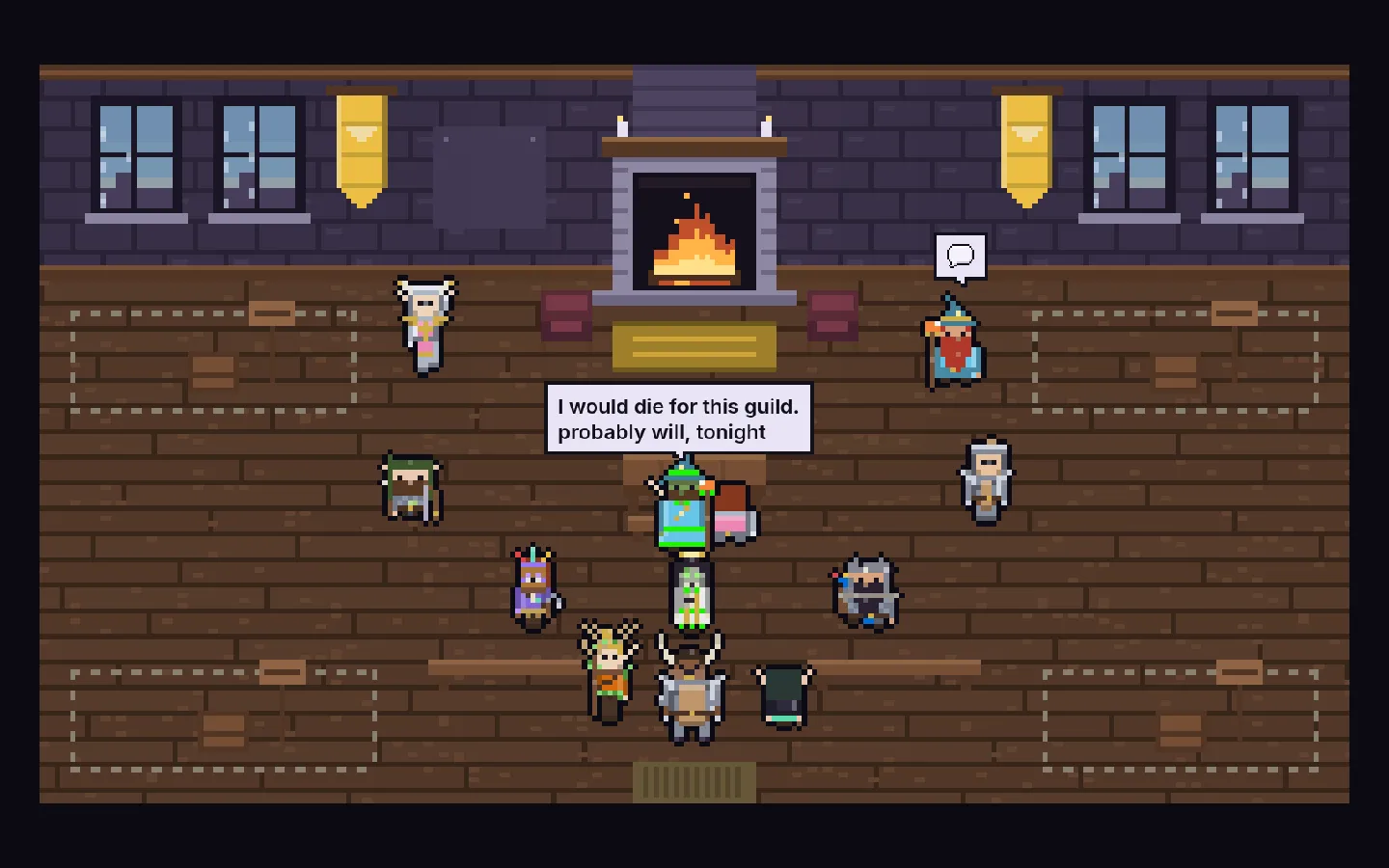
The guild hall in Highcrest: guildmates mill around the fireplace and chat.

The world

Aetheria: a mainland, the islands off its coast, and the Corsair Reaches beyond it.

Branching levelling

Six mainland questing zones, each for its own level range from 1–6 up to 26–30, and two island zones that overlap them, so levelling branches.

  • At those levels players pick a zone by their own taste and by how crowded it is, and stay while it fits.
  • Sea-loving streamers and show-offs lean to the islands; homebodies stay ashore.
  • Weather and omens change the day: fog, storms, heatwaves, ley-line surges.
Explore Aetheria
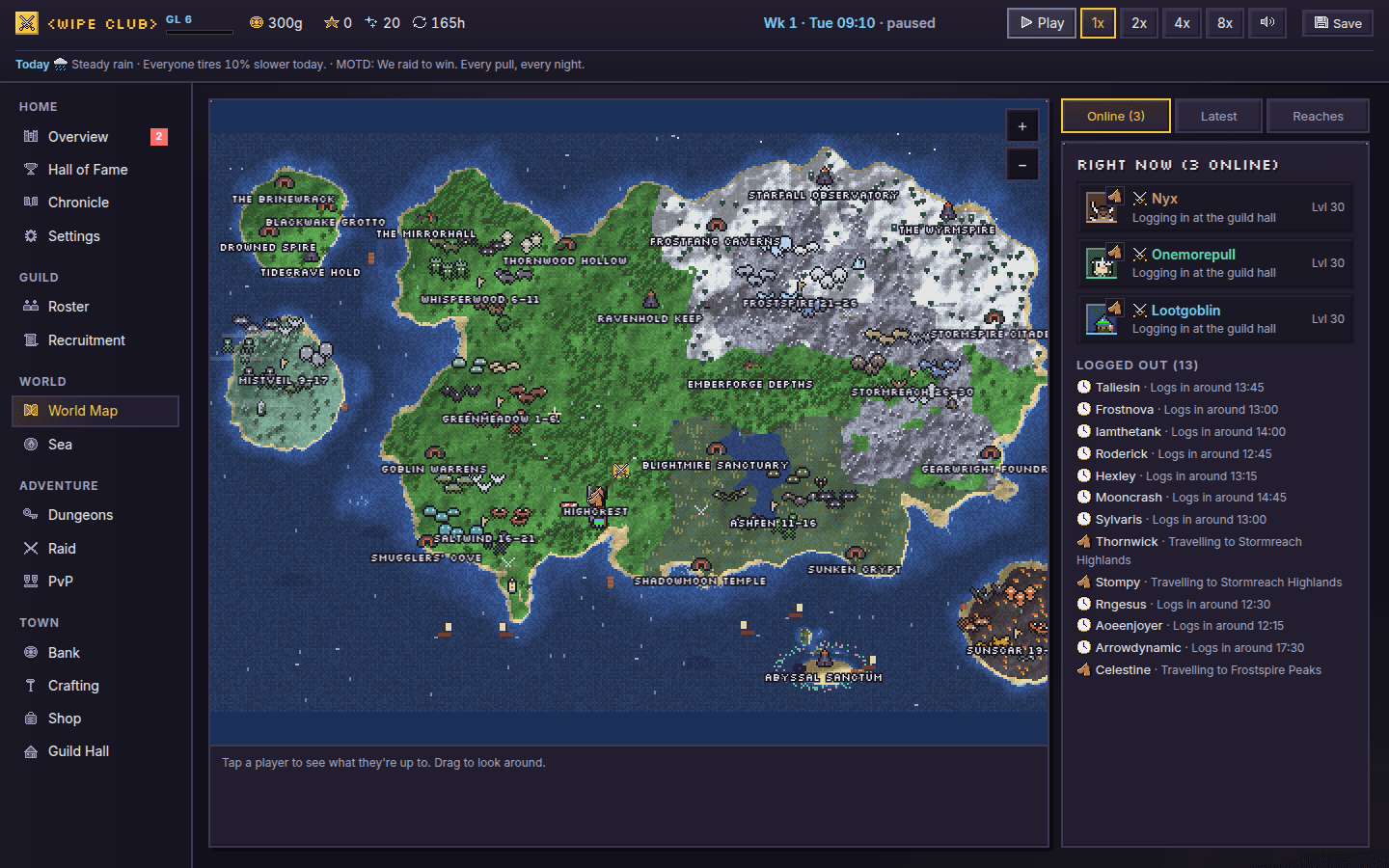
The world map screen: guildmates travelling between zones, with who is online and what they are doing on the right.

Islands and ferries

Ferries sail the sea lanes from the Highcrest Docks out to the islands off the coast, each lane with its own ship and its hours at sea. The crossings take real time out of a session, and island quests pay 30% more XP for it.

  • A trip sails the quickest chain of lanes; the Drowned Reef only by way of Port Cinder.
  • A walk that would cross the water becomes a walk to the docks, the crossing, and a walk from the far quay; the map draws the passengers on their ship.
  • Island bounties include the crossing there and back in their hours, and pay for it.
Every ferry, lane and crossing
The world map: a ferry with guildmates on deck crosses a sea lane.

Voyages in the Corsair Reaches

An ocean of its own, on its own chart, reached only by the guild’s ship from Saltmarrow harbour. Charts, supplies, fog to clear, islands to land on, ports to trade in and ships to fight.

  • Charts are routes you keep: bought, found or earned, and chained into longer voyages.
  • A voyage plays day by day with Sail on, while the guild’s days at home go on.
  • Engage, board, evade or pay tribute: the odds are shown before you choose. The Kraken waits in the Maw.
Voyaging in the Reaches
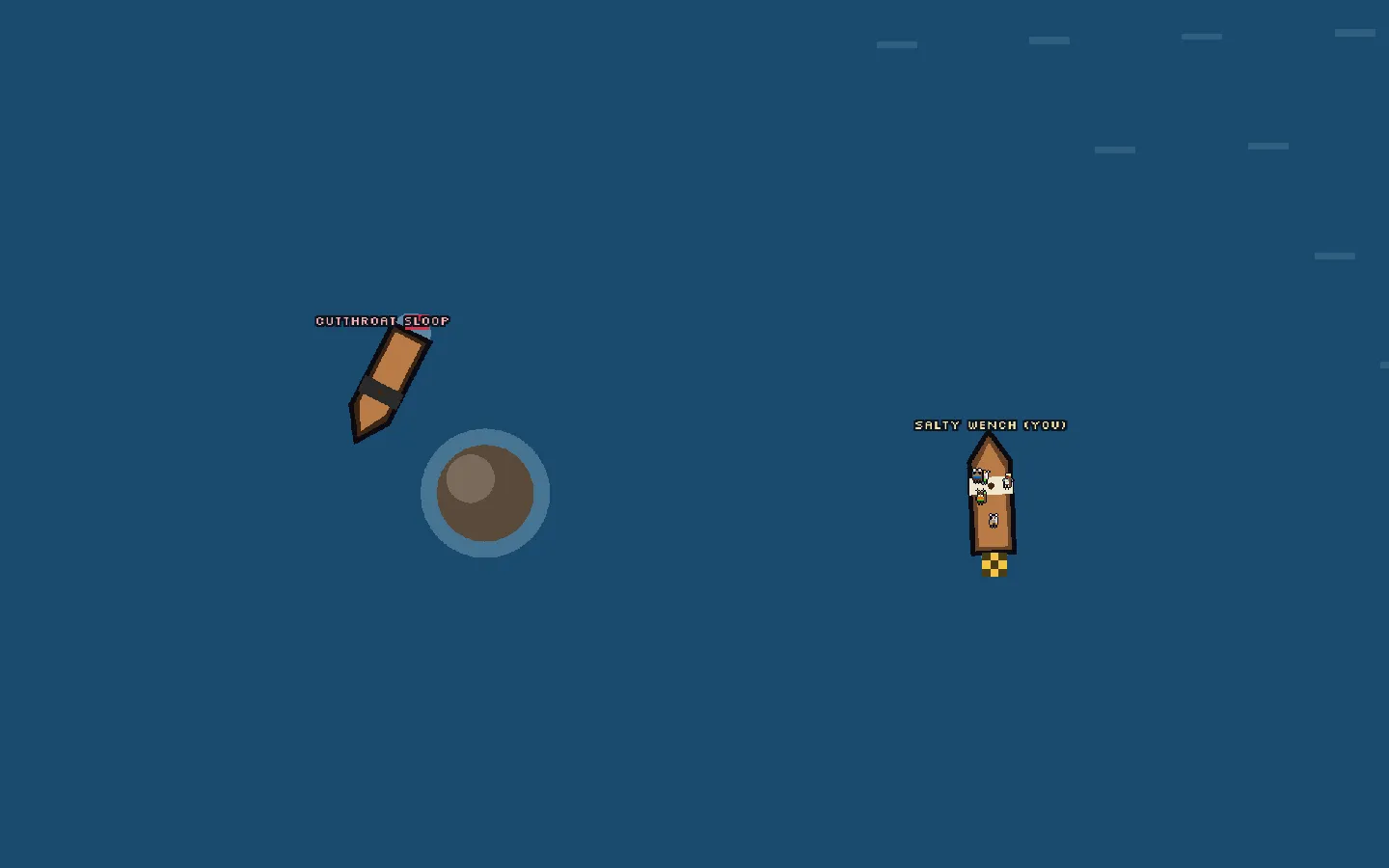
A sea fight in the Corsair Reaches: the guild’s sloop trades broadsides with a cutthroat sloop.

World bosses

The server’s rare spawns, forty players at a time. Every one of them has a fan wiki with a timer.

  • A demon lord who conquers one zone at a time, then forgets which one.
  • An ancient blue dragon that mostly naps, and wakes up for guilds with bad timing.
  • Rally whoever is online and bring pick-ups to fill the raid.
Meet the world bosses

World PvP and guild wars

Four contested zones (Ashfen, Saltwind, Frostspire, Stormreach) where guilds meet in the open.

  • Players skirmish there as a day’s activity: honor, a little XP and gold, the odd piece of gear.
  • Hostile guilds ambush your questers there (not in a new guild’s first week).
  • Declare war: wanted players with a price on their head, a weekly war score, gauntlets and truce offers.

The fights

Every dungeon pull and raid boss is a live, positional 2D combat simulation. Players are not perfect.

Positional combat

Telegraphs, projectiles to dodge, beams, donuts, soaks that punish too few soakers, marks that drop a burning pool where they leave it, adds, tank swaps and phases, in a themed room.

  • Players dodge late, dodge the wrong way, get tunnel vision and miss calls, more so with low awareness.
  • Summons are units of their own: a Houndmaster’s hound, a Swarmcaller’s ghoul, a Turretsmith’s sentry turret.
  • The camera follows the action, closing in on a tight fight and pulling back when it spreads.
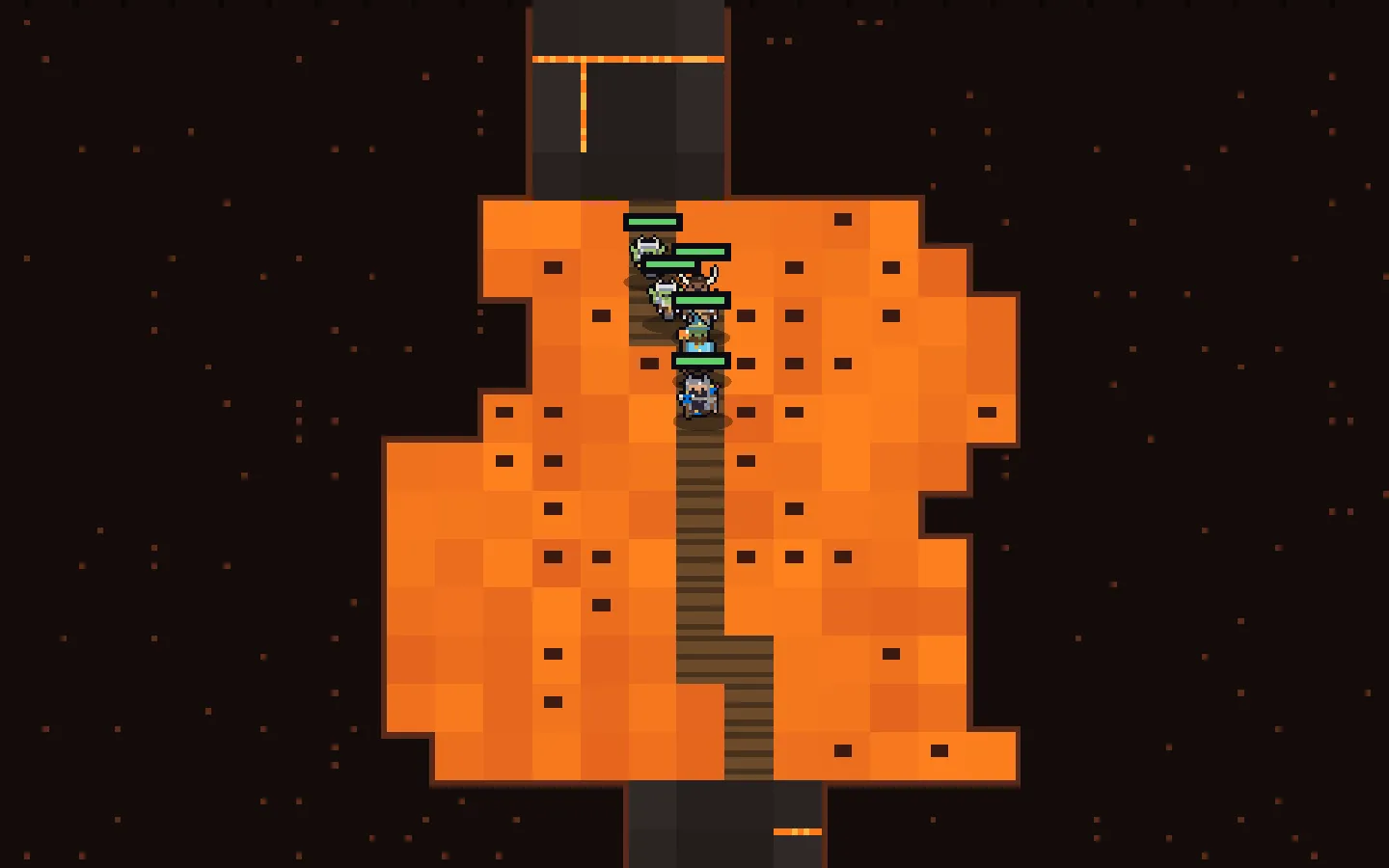
A live dungeon pull in the Gearwright Foundry: the group fights three clockwork sentries among lava channels, the leader calls War Drums, and the sentries fall.

Set-piece mechanics

Spread and stack, frontal cones aimed at a random player, interrupt rotations, intermissions, hard and soft enrages, and a lot more.

  • Dispels with a penalty (the plague jumps: step away first), kiting a fixated hunter, line of sight.
  • Knockbacks off open ledges, tethers to stretch until they snap, mind control (crowd-control the turned ally, don’t kill them).
  • Colour matching, platform hopping over lava, a maze of rising walls, a split realm, turrets to man against a flyer.
  • Enemies sharing one life, orbs to carry before they burst, and execute phases.

Your calls

For each boss and dungeon, tell the group how to play it. Then make live calls mid-pull: War Drums now, spread out, defensives, potions.

  • Safe or greedy on mechanics, damage on adds or boss, healers on tanks or everyone.
  • Spread or stacked, and whether to let the tank pull first.
  • After the pull each call gets a letter grade, A to F.

Real threat tables

Tanks make three times the threat and open each pull; healing makes threat too. You pull aggro at 110% of the holder’s threat in melee, 130% at range.

  • Sharp players watch the meter and ease off or use a threat drop.
  • The rest get flattened until a tank taunts it back.
  • Several raid bosses stack a debuff on their tank: the off-tank taunts them over, on time if they’re sharp. You call how early.

One continuous instance

Every room of a dungeon or raid is laid out in one place, joined by corridors, and the group walks it for real between pulls.

  • Twisty goblin tunnels, flooded crypt passages, single-file bridges over lava, pillared temple halls.
  • The careless, the greedy and streamers wander off toward something glinting down a side passage.
  • Enemies have an aggro range and packs are linked. Sneak past a pack if you dare: no fight, but no loot.
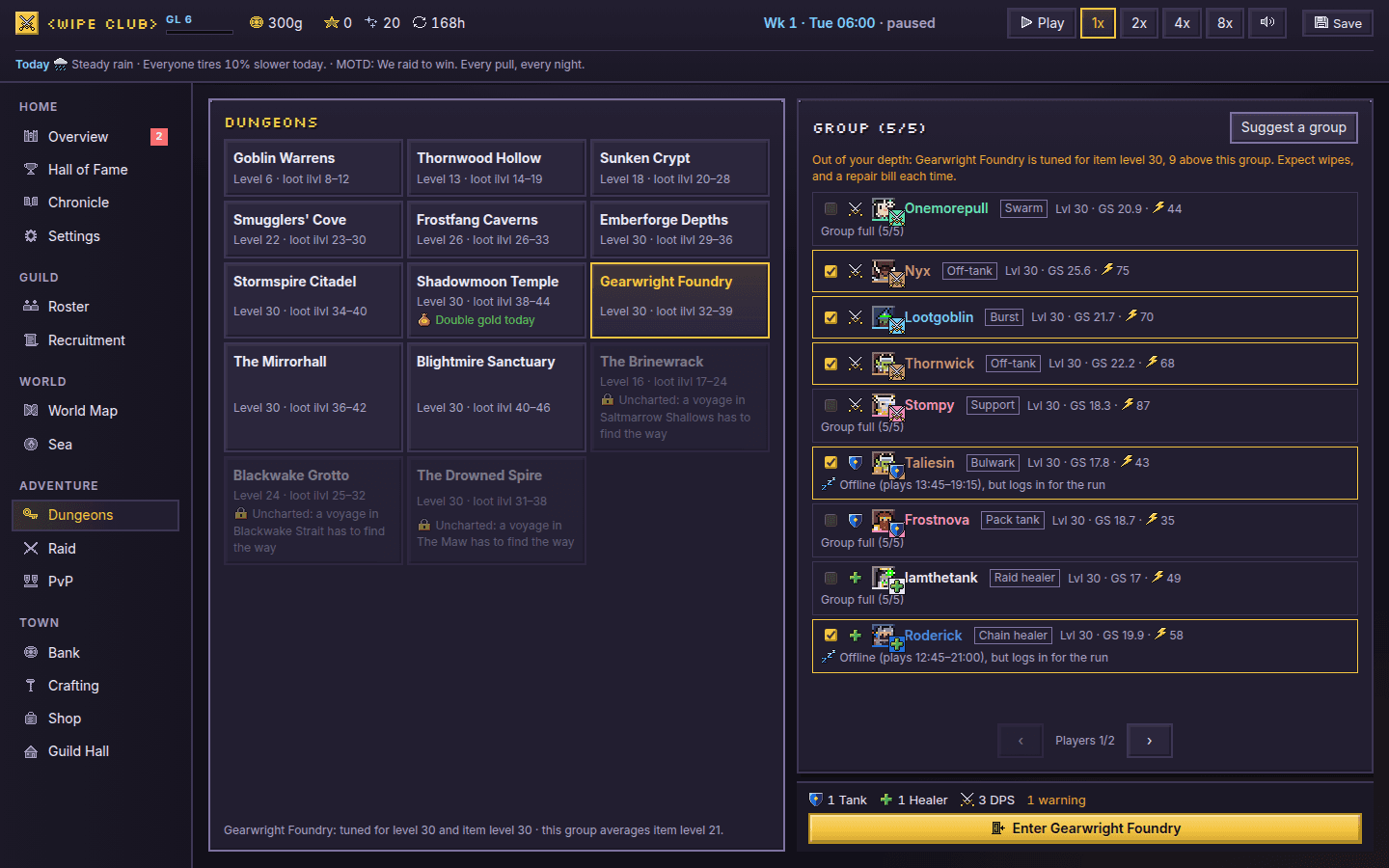
The dungeon screen: the dungeons to pick from and a five-player group with roles and gear scores.

Progression and lockouts

A new boss has to be learned. Every wipe teaches the raid a little, and the raid meets three nights a week, so a first clear takes a couple of months.

  • Raids lock for the week, guild-wide. Each dungeon, the arena and the battleground lock for the day.
  • Every raid boss is guarded by a pack that has to be cleared first, and it stays dead for the week.
  • Keystones never lock.

Dungeons, raids and PvP

Five-player dungeons, mythic keystones, raids, the arena and battlegrounds.

Dungeons and keystones

Five-player dungeons from level 6 to 30. At the cap they take mythic keystones with rotating affixes.

  • Three level-30 dungeons (the Gearwright Foundry, the Mirrorhall and Blightmire Sanctuary) are built around set-piece mechanics.
  • Every pull is your call: the group walks up to the next pack and waits at its door.
  • A wipe always holds for your call.
Every dungeon and boss

Raids

Two 10-player raids, Ravenhold Keep and Tidegrave Hold (a sea fortress the guild’s ships find), then the 20-player raids: the Wyrmspire, the Abyssal Sanctum under the Drowned Reef, and the Starfall Observatory.

  • Pick your group, then composition and positional assignments per boss.
  • Weekly lockout, repair bills, flasks and feasts.
  • No practice pulls: every pull counts.
Every raid and boss
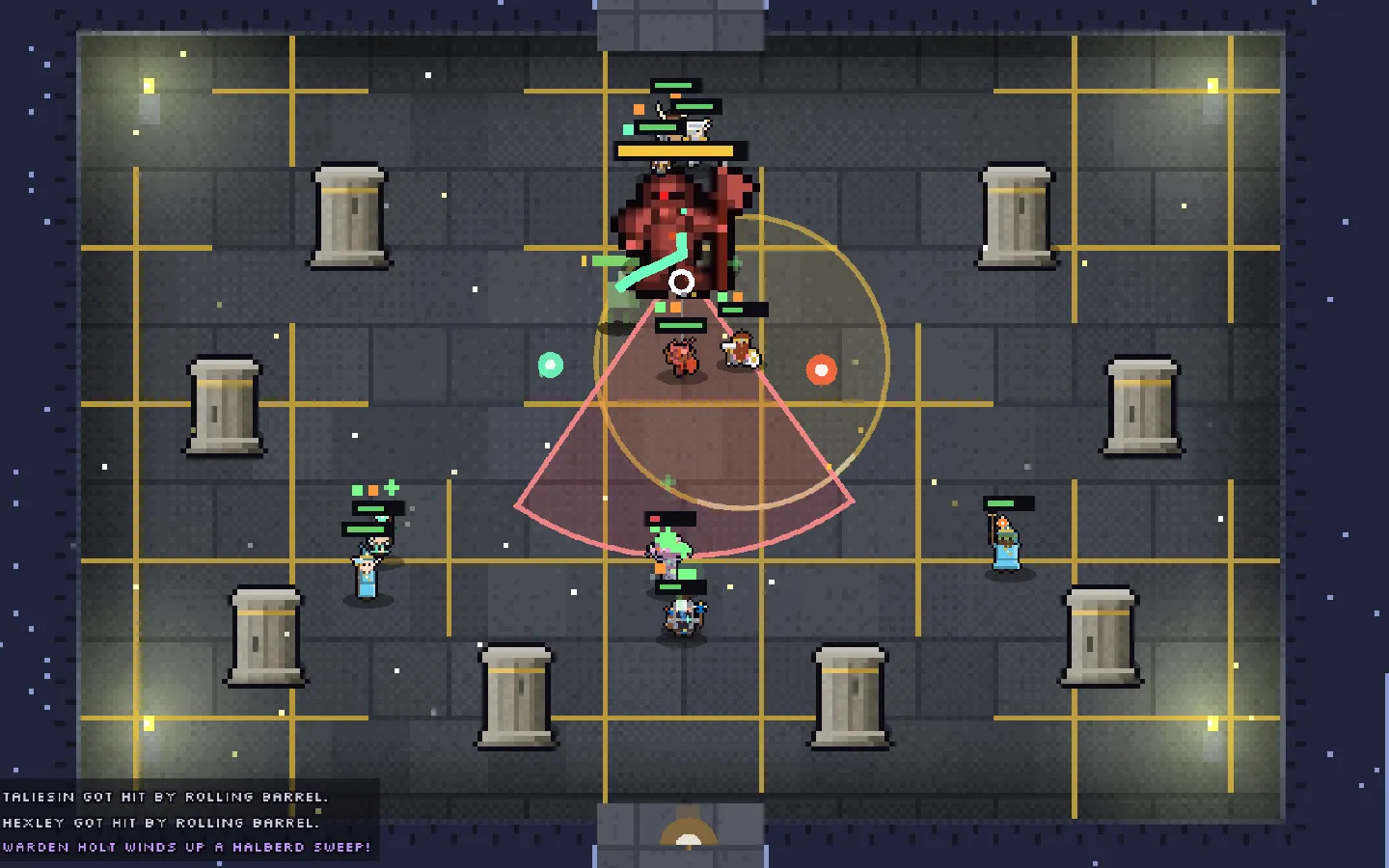
A raid boss in Ravenhold Keep: the raid spreads around the boss, steps out of its frontal cone and stands in the soak circles.

The arena

Once a day, take on an arena event: pick a 2v2, 3v3 or 5v5 team from whoever is online, queue, and another guild’s team answers.

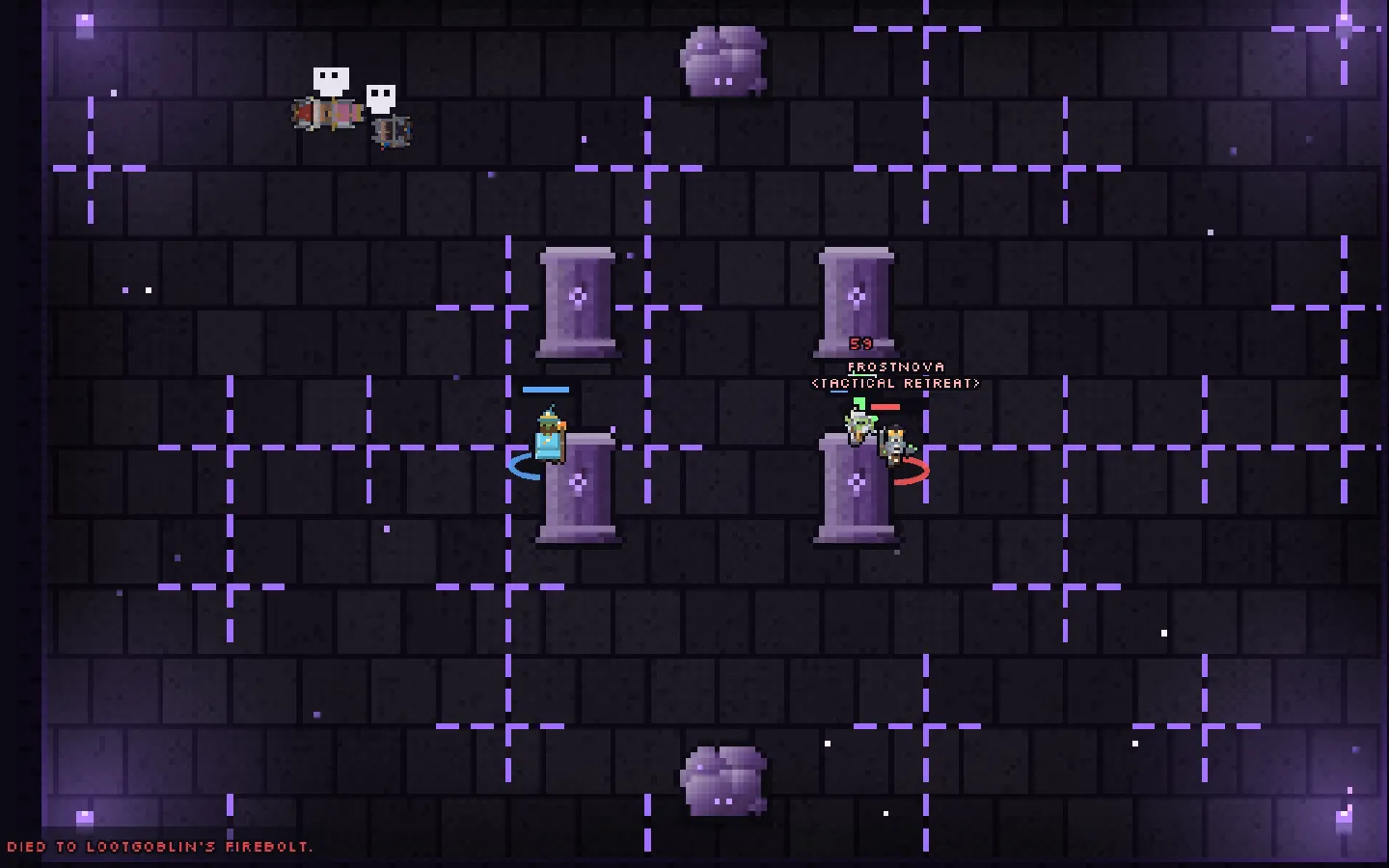
  • A best of three, called live: focus their healer, burst now, peel for your healer, defensives.
  • Crowd control with diminishing returns, big heals the other side kicks, pillars to break line of sight.
  • Elo ratings, tiers from Combatant to Gladiator, and 8-week seasons with titles.
A 3v3 arena match against another guild’s team among pillars: the leader calls defensives and a focus target, and both sides stun and silence each other.

Battlegrounds

Once a day, a 10v10 battleground: ten of your own players against another guild’s ten, on a capture-the-flag map or a hold-the-nodes map.

  • Flags are lifted, carried, dropped and returned; nodes change hands with whoever outnumbers the other side.
  • Called live: push, defend, focus their healer, burst now.
  • Wins pay honor, gold, XP and sometimes gear. Honor buys gear, components or gold.

Play anywhere

A browser game for desktop and phone, free and open source.

Local or cloud saves

Play locally in the browser, or sign in for three cloud save slots with conflict detection.

  • Install it to your phone’s home screen: phones are a first-class layout, not a squeeze.
  • Keyboard shortcuts on desktop: Space pauses, 1–9 jump between screens, and in a fight 1–7 make the calls.

Free software

Raid Leader Simulator is free software under the GNU AGPL v3. Its music and sound effects are played live by Strudel.

  • The simulation is pure and deterministic TypeScript: every fight honestly plays out your decisions.
  • Get the source from the About panel in the game’s Settings, or on GitHub.